Gendered Verbal Communication

I thought it was fascinating when the author said that language is the main way one expresses gender. It is a way to perform femininity or masculinity. Males learned to communicate in feminine modes and, so it is the same for females. Isn't that amazing! We always think that barriers in communication are a result of different backgrounds or cultures, but not still believe that the difference is part of gender singularities. Of course, when the talk is about the relationship, then the colliding interpretations are relevant, especially the following five, brought about by Wood on chapter 5:
- Showing support: did you know that in the male mode, support equals condescending, but not for females mode. Advice to male equals comfort; on the other hand, females see it as a feeling dismissal.
- Troubles talk: how many hadn't been hurt or sad when sharing personal problems with the opposite gender? Did you know that in the female language, when the other person acknowledges that others have gone through it too, it means dismissing and belittle them? And on the male language, it means respect? When is the other way around, in masculine verbal communication style sympathizing, for their problems or troubles means intruding, and being vulnerable pushes the withdrawn button? Better yet, if she sympathized with saying she understands, being there and sharing her story, means to them you are stealing the center of attention to yourself. Did you know it?
- The point of the story: I think on this one, we are pretty much aware of the differences. As to going to the point vs. detailed, not linear story.
- Relationship talk: Did you know that "talking about us" for a male communicating standpoint, means we have a problem to solve? For a female, not talking about us means the relationship is in trouble?
- Public speaking: is base on male communication. You should be assertive, dominant, confident, and being perceived as qualified.
What to do? One step will be to understand, validate, and respect each other's set of rules in communication and interpret them to have better communication. Putting our feelings aside and move to interpretation and growth in our interrelationships.
I can only laugh, recalling my experiences on the subject matter, and can't wait to see what happens now that I know these clues or norms in communication.
Take a stand: Can you identify connections among traditional childhood games, video games, and gendered communication patterns? Absolutely, boys will have as toys, soldiers, police cars, firefighter trucks, heroes, and video games will be sports games such as soccer or baseball. Boys are superheroes; they are strong and tough. Girls, on the other hand, will have as toys a kitchen with their cooking things, a baby doll with its stroller, a barbie, on my experience, girls did not play video games, it seems like there was nothing for them to play on it. For the girls, the tendency was to be caring, kind, and supportive; usually, they were teachers or moms. Their games were around those patterns.
Gendered Nonverbal Communication (chapter 6)
Take a stand section of chapter 6: To what extent do you think specifically gendered action figures make a difference in children's socialization? If nonverbal communication is key, and as children grow, they mimic what they see and hear from their loved ones and the media. I have seen in different cultural settings how a kid will treat others based on who they are portraying as a result of the toy they admired or like, there was a kid that was trying to be a hero, he will destroy so many things and make huge messes from his room all the way to the living room because he was saving his imaginary friend. Girls will be nice to babies when they have a baby doll but will act very emotional and spoiled when they play with barbies or will play with fancy clothes from mommy closet or princess outfits. Both will ask the other gender friends to leave because they were not suitable for the game. Go figure!
| Retrieve from: https://www.nbcnews.com/news/us-news/target-ditches-gendered-labels-toys-home-entertainment-n406741 |
Take a stand: To what extent do you think cosmetic procedures, such as liposuction and Botox injections, are different than wearing makeup or having body piercings or tattoos? The motives seem the same appearance, and the purpose is to enhance/change the appearance. It is all about the look, on my perspective, or what I think others think. The difference could be in the long run results, one could be overturned by just wiping it out, but the other does not. One could be more expensive than the other one. One is looking to cover up while the other is looking for a "permanent" change in the appearance. It is very hard in our society to see ourselves and be happy and proud of what the mirror shows, when for hours, days, and years we have let ourselves being bombarded by the media and place those as the standards in which comparison is unavoidable and our views distorted enough to look for the next thing that will fix us to be happy and feel beautiful, and that is the beginning of one thing to fix after another.
Becoming Gendered (chapter 7)
What a topic! In summary, children learn gender from their family and culture. Our gender identity is formed in the early years, according to Wood's research. Based on Freud's studies, girls identify with their mom and boys with their father if, by any chance, they do not have that figure in their home, they will shape it based on what it is not. How key it is for us to leave in a community close to family where the missing main figures can be "replaced" by their uncle, aunt, grandma, grandpa, pastor, teacher. Then, of course, media plays its role, and toys, too, as we notice in the chapter above.
Parents, as their children grow, will play different maybe upgrade the roles. For our experiences as children unless on my end, you might wish your dad or mom treated you "equally"... when I was a girl, my dad would not let me play outside when the boys were playing because I could get hurt and because those were boys games - soccer, hide and seek, the warriors, the monsters, among others. Now the fun was when dad was at work… Sweet moments... I got to climb our mango trees and play with everyone there; it was no difference, so much fun to play outside in our backyard. I did grow up with a neighbor boy that acted a lot like a girl. I don't remember paying attention to that; we have a lot of fun playing, and that was what it mattered. I do remember how much they make fun of him, but he did not seem to care, of course, there were a lot of kids that will defend him.
Take a stand section: To what extent do your experiences confirm or challenge these as dominant media images of men today? These are referred to as the two main media characters, the aggressive and at times violent superhero, with high power weapons, who treat women with disrespect or exploits them. The other character is the opposite the slacker, the one that won't do or aspire to anything. In my experience, I have seen and interact with both extremes, and it is very sad and does not feel right at all. I don't think a man has to be aggressive, senseless, and disrespectful to be respected, to be a man, and either the other extreme. A few movies disturbed me when men were presented with a lack of intelligence and aspirations. When I reflect on it, I talk to my husband about how I felt that was not right, and I began to check my thoughts, patterns, and other emotions that I did not notice were a reaction to what I had watched that get fixed in my mind as truth. I did cry, how in the world, I saw God's most precious gift to me as less or incapable! Since I had been intentional of what I say and do is to lift the men on my life and to let them know how much I respect them just for being God's son. Follow this link for a National Geographic article https://www.nationalgeographic.com/magazine/2017/01/gender-toys-departments-piece/
Gendered Power and Violence (chapter 12)
It is as the author will sum it up: the many faces of gendered violence. You and I will be puzzled as to the many faces of gendered violence and how much we should be intentional in our minute's life to break the cycle and to make a better place around us and for our generations to come.
Gender intimidation exists because of gender, sex, or sexual orientation, making someone feeling vulnerable or unsafe. There is also, Genital surgery such as vacation cutting, and gender-based murder, yes how it comes that when both sexes are exposed to regular care both flourished, but female outnumbers boys, and in other places, boys outnumber — something to think about.
Sexual harassment a plague that has been damaging work environments, the second home to almost everyone. Not just limited to Quid pro quo but as harmful as this, the hostile environment when producing and much more is impaired as a result of intimidating, offensive sexualized content or behavior as Wood & Fixmer-Oraiz expressed. Work, school, universities had been harmed by this unacceptable behavior, whether it is conscious or unconscious.
Sexual assault encompassing what we know already by alarming when becoming the highest threat to every student on a college campus. We must change the chip of how to guard ourselves in this day to day realities and how to stop the rape culture and the normalization of something that it is not normal or ok. Rape is not ok or standard in any circumstance, and no one, no one deserves or asks for it.
Intimate partner violence is another facet of the gendered violence that "came to stay" if we keep on believing the myths about it. No one should "got flowers today."
No one should "got flowers today," not a woman, not a man, not a child, no one.
So many ways to stop gendered violence, yet it seems as it just got fuel when the new trends come to light, in the end, the golden rule applies in this context, too. Take a stand and choose to make your voice stronger by acknowledging these realities and think about them, get involved in ways to help on stopping gendered violence, support those that refuse to be defeated by this type of brutality. It is a process. It stars in me and with me.
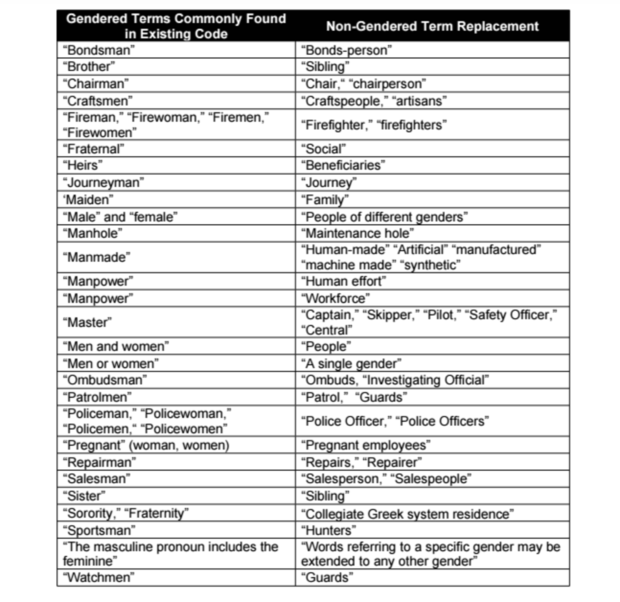
Reflections on the article "City to ban gendered language like 'manhole', 'manpower' and 'firemen'" in California click link for details. In an effort to promote inclusion replacing words and gender-oriented phrases is a start, (although we should be careful not to fall into a so vague or so neutral way of addressing someone that will give the sense of being ignored/not taking into account) but they should also make efforts to treat the underlying cause and go to the root of this complex societal issue that has over boiled after diversifying genders.
Inclusion on these terms could be like "making the road" to address the more prominent influencers in the lives of humanity and the opportunity to open dialogues and make commitments to treat and respect one another regardless. Because it is not only about gender; it is also impacting and including race, culture, society. It goes beyond the fence of who you think you are or who you think you want to be gendered speaking, because the view of other races and cultures should also be explored as consequence of changes in pro of inclusion.
If you would like to see a few of the common terms replaced see the chart below, retrieve from the same article:

I do agree that make-up is temporary action while tattooing is permanent alteration. There are methods of removal I hear, yet what a task to try to undo something that was so painful to begin with? We have a task each day as we fight to know and preserve our inner value against what the media and society say should be the standard.
ReplyDeleteI, too, agree that men do not need to be aggressive, senseless, and disrespectful to be respected. Unfortunately, society and the media says otherwise. I believe the only thing we can do to change all that is to be mindful of the media and our cultural influences and strive to teach the next generation differently.
ReplyDeleteToys, make-up, flowers; from the cradle to the grave, women have been largely the recipients and men the purveyors; I wonder how different the stories would be if the tables were turned?
ReplyDelete